 The summer blockbuster season has arrived and it seems that the words of the day are “time travel.” Time travel is all the rage, and appears prominently in the latest “Star Trek” installment, as well as being a key element of Terminator: Salvation. Time travel was also a frequent theme of the Terminator television series, and of course is crucial to ABC’s ever popular LOST.
Time Travel in Science Fiction

While the latest Star Trek movie installment was hailed as “original” and “groundbreaking,” time travel is actually an extremely common element of the Star Trek series. It was the theme of four Star Trek Movies (“The Voyage Home,” “Generations” and “First Contact,” in addition to the latest installment), and has appeared multiple times in every Star Trek series (TOS: City on the Edge of Forever, Assignment: Earth, TNG: Yesterday’s Enterprise, Time’s Arrow, DS9: Little Green Men, Trials and Tribble-ations, VOY: Future’s End, Relativity, ST:E: Cold Front, Zero Hour).
The Terminator series is completely reliant on time travel to tell its story. Clearly time travel is a popular device for purveyors of science fiction. So why do I hate it so much?
Problems with Time Travel

My problems with time travel, like time travel itself, span multiple dimensions. These dimensions are Physical, Metaphysical, Logical and Aesthetic. To address each of these in turn:
Physical:

Time travel the way it is depicted in most fiction is impossible. This, frankly, is the least of my concerns with time travel, as science fiction is generally predicated on the impossible. However, I just thought I’d put it out there. The whole idea of time travel is usually designed around Einstein’s Relativity theories, which essentially state that how fast time moves depends on your perspective, and that space and time exist together along a continuum. The faster you are moving and the farther away you are from an object, the slower time appears to you relative to the object that isn’t moving as fast or that you are far away from. The theory continues to suggest that if you could move fast enough, you could theoretically move backwards through the time stream, and there are in fact particles that do this, called tachyons.
The problem with all of this for say, Ambassador Spock, is that as one approaches the speed of light, one’s mass becomes infinite, and the human (or Vulcan) body is not really equipped for infinite mass, so anyone traveling through a black hole or some kind of particle accelerator might reappear back in time, but they would do so as so much mush.
Metaphysical:
 Again, the physical objection is no big deal. Superman shouldn’t be able to fly either and I’m fine with that. I’m also not too caught up in the metaphysical problems, but I should address them as well.
The metaphysical problems are the paradoxes. There is the classic “Grandfather Paradox;” if you go back in time and kill your grandfather, you will never be born, and therefore you can never go back in time to kill your grandfather. There is the equally troubling “Ontological Paradox,” which comes up much more often. For example in Terminator, John Connor sends Kyle Reese back to protect his mother. Reese ends up in a relationship with Connor’s mother and becomes his father. But who was there to send Reese back the “first time?” That is to say, before the events of Judgment Day happened, who fathered John Connor?
Another example occurs in Star Trek. Scotty needs to transport the heroes onto a moving spaceship, but the technology hasn’t been invented yet. Future Spock assures Scotty that he will one day invent such technology, and in fact provides New Scotty with the required information. The question now becomes, where did this information come from in the first place?
It also appears in LOST. Richard Alpert in the past gives Locke a compass. Locke later gives this compass to Alpert with instructions to give it to him in the past. So what is the compass’ origin? Again, there is a rebuttal to these paradoxes, and these issues don’t concern me overmuch, although they are annoying.
Logical:

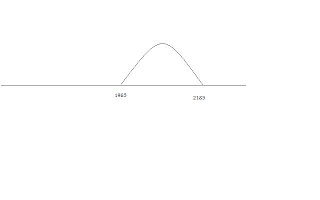
The logical objection IS one that concerns me. Although there is a rebuttal, it is NEVER used in fiction to my knowledge, certainly not in Star Trek movies. Here goes. The premise of this objection is that time travel isn’t possible because it doesn’t exist right now. You can’t say “it hasn’t been invented yet” because there is no “yet,” since time travel is involved. If it is discovered anywhere in the timestream, then it must exist everywhere. Some might argue that this is okay because whoever travelled back kept it a secret, or met people who could not understand or evaluate the technology. But that assumes that time travel works like so:
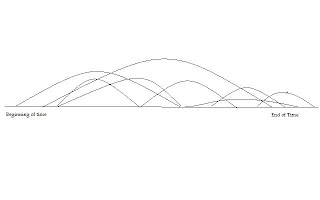 For as long as human beings exist in time, people will be going back, making anachronistic holes in the time line like so much swiss cheese. With an infinite number of travelers, eventually one will make time travel technology possible at an earlier time, which will then lead to infinitely more travelers between that earlier time and other times, until time travelers are EVERYWHERE. And as far as I can tell, they are not.
Aesthetic:

There are even rebuttals to the logical argument, but there is no rebuttal to the aesthetic argument, which is that time travel is just messy. In Star Trek, the 2009 movie, The Romulans go back in time and wipe out Vulcan. This causes the hundreds of years of fictional history and the decades of real Star Trek history to be wiped out. All the great Star Trek mythology you thrilled to as a child, well, most of it just never happened, cause the Romulans went back in time. How then, can I be expected to invest myself in this new group of characters, when I know that someday, the Romulans could go back in time and destroy the escape ship that contained the unborn Captain Kirk, or destroy the Earth in 1776, or take over the Federation in 2214 with advanced 25th century technology?
Furthermore, there is the Slippery Slope issue which I find so grating that the story is nearly impossible for me to enjoy. In Star Trek, the Romulan mining ship goes back in time and destroys Vulcan. Now that Starfleet is aware of this, why not send a Starfleet force back to where the Romulans will someday pop into the sky and destroy them before they do it? Why not send an espionage force to kill Captain Nero’s mother, a la Terminator? It seems to me that if you can go back and change things, you can always send someone somewhere else in the timeline to change things back. And that’s why I hate time travel stories.
Note: There are some valid rebuttals to all but the aesthetic argument, and hence some time travel concepts/stories that work. I’ll address those in my next post.


 and I don't think that it has any bearing on her position on gay marriage. I don't really think Miss Prejean is a bigot, I think she's a kid who was taught bigotry by her family and friends and just doesn't know any better. Perhaps this controversy will help her learn. Then maybe something useful will have come out of a beauty pageant for once.


 The second main event ever, what makes this one notable is how it ended. Back in 1972, poker was a game of smokey backrooms, and unlike today, no one was interested in becoming a celebrity, save one: Amarillo Slim Preston. When it reached the final three, Doyle Brunson simply took his money and withdrew, an option not available today, and Puggy Pearson dumped to Slim to avoid the spotlight. Slim made the most of the win though, and by appearing on programs like the Tonight Show, became the first poker celebrity and helped to improve the game's image, decades before the poker boom.
 What's memorable about 1998 is it was one of the most watched finals before the poker boom. Scotty's goading comment to runner up Kevin McBride, causing him to go all in when he could only play the board, is one of the enduring memories of older poker fans, and Scotty remains one of the most well-known and top pros in the game today.
 Two years before Chris Moneymaker and hole card cameras put the WSOP on the map was a final table that ESPN would drool at the prospect of televising today. In addition to eventual champion and future WPT main event champion Carlos Mortensen, the final six featured two time 2nd place finisher Dewey Tomko, former champion and all time bracelet holder Phil Hellmuth, two time final tablist and well-known poker celebrity Mike Matusow and popular player and commentator Phil Gordon. Even more amazingly, probably the most recognizable face in poker today, Daniel Negreanu, just missed the final table, finishing 11th.


 Off the bat,
  The movie looked cool. There was no doubt about it. Modern technology enables the filmmaker the ability to bring this material to life in a way that no one could have ever dreamed possible in 1985, and its great to have the opportunity to see it.


 While people unfamiliar with Watchmen will probably think of characters like
 Many poker players deep in their hearts believe that they are stronger players than their results would indicate. Now, poker "experts" will mockingly chalk this up to an excess of ego or some fundamental misunderstanding of the game, but in fact it is much more complicated than this. We find the same misattribution in chess, where rated players will often overestimate their "strength" as being several hundred points higher than their rating, attributing the differential to some flaw in the rating system.


 The idea of hunting animals for sport is not for me, although I get it. Without recreational hunters, we probably don't have professional hunters, and I do think that it is natural and healthy for humans to eat meat (in moderation). However, playing an animal hunting video game makes no sense to me. The whole idea of video games is that you can kill PEOPLE with no consequences. To me that seems a lot more fun and challenging than killing a cute animal.


 Unfortunately, the victory is bittersweet for patriots here in California due to the passage of Proposition 8, an amendment to take rights away from Gay Americans, and the passage of similar laws throughout the country.







.jpg)


