Friday, April 30, 2010

I Shouldn't Even Be Writing This Right Now...

It's been a crazy week. At the beginning of the week, I was informed that I won a Fellowship to the prestigious Writers Boot Camp program, with a development deal on the line. Of course, assignments, which I'll be getting every two weeks for the next six months, start immediately.

Yesterday, I found out that I was a semifinalist in the Storyboard TV Writing Competition. This time, a potential production deal is on the line. They requested a rewrite (in addition to a bunch of paperwork) by May 1st. Yeah, THAT May 1st. Like, tomorrow. Like, yeah, I found out yesterday.

Add to this the fact that I have a weird work situation which I won't get into here, but the bottom line is I have a bunch of catching up to do in that arena as well, plus I recently hired a script consultant who gave me a bunch more work for two weeks from now, and I find myself in a ridiculous workload/deadline situation.

I read once that being a writer is like having homework for the rest of your life. Seems that the teachers are piling it on this week.

Anyway, that's why the blogging is suffering (no excuse for why it was suffering, say, three weeks ago, but then, my stated policy is not to make excuses for not blogging).

Sunday, April 04, 2010

Five Comic Book Series Where Superman is the Bad Guy

In my parents' generation, Superman was the be-all and end-all of superheroes. However, by the time I got to reading comic books, readership had gotten a little more sophisticated, and a lot of people realized that a hero who could do anything and couldn't really be hurt (except by the contrived use of Kryptonite, or a villain who was "even stronger" than Superman) was not that interesting.

Today, that generation is largely the one writing (and reading) comics, so the take on Superman has gotten a little different. In effect, a number of writers have realized that it's much more interesting if Superman is the bad guy. Not a temporary bad guy, like when Superman is under the effects of red kryptonite, but really a nearly all-powerful being of questionable morality. If you like your Superman evil, here are five guys you should definitely take a look at.

The Plutonian (Irredeemable; Mark Waid, Peter Krause)
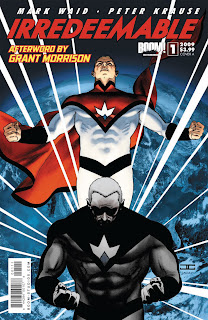
In probably one of the best examples of the genre going today, Mark Waid explores the idea of the evil Superman with a character who didn't start out that way. That is, he was the same do-gooder Superman was, day in and day out, despite his growing umbrage at the complete lack of appreciation and feeling of being taken for granted by the citizens he protects. Until something really bad happened. After that bad thing, the Plutonian decided he might as well take the world for his own, destroying anything or anyone that got in his way, including, for example, the nation of Singapore, which he utterly destroys when they unite to resist him. What was the really bad thing? Can anyone stop the Plutonian? Check out Irredeemable.

The Homelander (The Boys; Garth Ennis, Darick Robertson)
Is the Homelander evil, or just supremely self-interested? In a world where virtually all superheroes are raging fonts of pure id, this Superman fits right in. He does lead a "Justice League" type group (The Seven) dedicated to saving humanity. On the other hand, that group is in the pocket of a mega-corporation, and he takes time out from his good deeds to, for example, force a young new female recruit to the group to perform oral sex on him, so he's pretty far from a "good" guy.

Hyperion (Supreme Power; J. Michael Straczynski, Gary Frank)


40 years ago, Roy Thomas and John Buscema created the Squadron Supreme, a group designed to be Marvel Comics' answer to the Justice League of America. Each JLA member had its Squadron alternate, with Hyperion, of course, being Superman. Ten years later, Mark Gruenwald reimagined this group with the revolutionary idea that a team of unbeatable superheroes would naturally decide it was appropriate for them to govern the world (this idea reached its apotheosis in the groundbreaking The Authority, by Warren Ellis). In the 21st century, J. Michael Stracyznski reimagined Hyperion again. In this incarnation, the U.S. government, seeing the unidentified object streaking through the sky, took the young alien away from "Jonathan and Martha" immediately, raising him from infancy to be a super weapon. Naturally, spending your life as a government tool gets grating after awhile, and as soon as Hyperion was old enough to know better, he set about using his Supreme Power to rule the world.

Ultraman (Earth-2; Grant Morrison, Frank Quitely)

While these others are merely imitations of Superman, Ultraman really IS Superman, the Superman of a parallel universe where good and evil are reversed, going back at least as far as Benedict Arnold heroically betraying the British for the cause of the United States. In Earth-2, it's a given that the supers run things, and the real conflict is between these godlike being themselves. The biggest conflict, naturally, is between Ultraman and his world's Batman counterpart, Owlman. The main point of contention? They're both sleeping with Wonder Woman (Superwoman, in this reality).

Omni-Man (Invincible; Robert Kirkman, Cory Walker)

Invincible tells the story of Mark Grayson, a seemingly charmed teenager whose father happens to be Earth's greatest hero. Things get better and better for Mark, as he develops his own nearly limitless super powers and gets a hot girlfriend to boot. Of course, this wouldn't be much of a story if things didn't go downhill, and they do in a big way, when Mark discovers that his father, Omni-Man, is no hero at all, but in fact the lead scout of an alien invasion force. Eventually, after fathering children with aliens from two different worlds he was supposed to conquer, Omni-Man seems to have a change of heart, but it may be too late.

So to repeat, if you like your Superman on the wrong side of the law, head to your local bookstore and check out one of these titles.

Saturday, March 06, 2010

5 Lesser Known DC Comics Properties That Should Be Made into Movies


According to recent buzz, DC Comics is finally planning to give in and follow Marvel onto the big screen in a more expansive way. DC is ready to compete with Marvel in the Hollywood arena, preparing big screen versions of Green Lantern and Jonah Hex. I'm hoping they decide to follow Marvel's lead in throwing in some films featuring lesser known characters (e.g. Ghost Rider, Daredevil, etc.). Here are five lesser known D.C. properties I'd like to see made into major motion pictures.


Deadman


Deadman was the story of Boston Brand, a circus aerialist who was shot by an assassin in the middle of his routine. The ancient deity Rama Kushna took pity on Boston, and gave him the ability to roam the world as a ghost, righting wrongs as he searched for the man who shot him and the reason why. Since being a ghost in itself isn't much of a power, Boston had the ability to possess other human beings, using them as tools in his crusade to do good and find out the truth about his death.

I think Deadman would make a great movie. For one, it is a story with a beginning, a middle and an ending (with a twist, which I won't reveal here). For another, it is a very human story, and even as a ghost, Brand is subject to human weaknesses (one of the best conceits of the series was Brand's frustration trying to pull his aerialist moves in bodies that clearly weren't designed for them, i.e. your average, fat, out of shape American couch potato). In fact (surprise!) I'd be very willing to write the screenplay.

Swamp Thing


Now that the seal on Alan Moore properties has been completely torn off, it's time to make a Swamp Thing movie. Moore completely revolutionized mainstream comics with his take on ST, not as a man who has become a vegetable, but as a vegetable who thinks he is a man. It sounds silly on the page, but this story of a creature who comes to accept the loss of a humanity he never actually possessed is actually quite poignant.

Hawkworld


The origin of Hawkman has been put through several wringers leading up to the modern day, but the best interpretation has to have been Tim Truman and John Ostrander's, back in the late '80s early '90s. This series relied heavily on the idea of the Hawks as a pair of alien policemen, one of noble birth and one from the streets, and the politics of the planet Thanagar figured as heavily in the plots as your basic super hero doings, an idea that I think would work well for modern audiences.

Camelot 3000


Fans of Arthurian mythology and science fiction alike could get behind this limited series, which asked the question: What would happen if the Knights of the Round Table were reincarnated in the year 3000 to thwart an ancient evil? The answer: something very entertaining.

Firestorm
The ultimate attempt to bridge the generation gap, Firestorm was two men in one, teenage rebel Ronnie Raymond and stodgy science Professor Martin Stein, who were fused together in a nuclear explosion and forced to work as one to fight evil. This would be a great opportunity to pair an old favorite star with one of the new millenium's finest: Think Bryan Cranston and Aaron Paul from "Breaking Bad."

Saturday, February 27, 2010

Arrivederci, Vancouver

Where have I been? I promised myself when I started this blog that I would never have one of those "sorry I haven't been posting" posts, so I say by way of explanation, not excuse, that I have been busy watching the Olympics. (Also, it's tax season, so financial services professional and faithful CHP reader Bill Saas has had less free time and therefore less reason to harrass me about not blogging).

I love the Winter Olympics. More so than the Summer Olympics. I love the speed. I love the crashes. I love how the United States is not guaranteed to win practically every event, so it's exciting when they do. I love seeing sporting activities that I only get to see every four years, like Biathlon and Snowboard Cross racing. I especially love it now that I have TiVo to whiz past the down time and the fluff pieces.

So, since I've been gone watching the Winter Olympics, here's my analysis, as they draw to a close:

The Thrill of Victory

As always, the Winter Olympics produced (or NBC produced, depending upon how you look at it), some great stories. For me, the best ones were the following:

Bode Miller:

In Turin, Alpine Skiing great Bode Miller was the Sports Illustrated golden boy. He was a World Cup monster, and was predicted to bring home a big haul of treasure for the United States. And he knew it. He played the obnoxious rockstar athlete to the hilt, and, to my personal satisfaction, completely crapped out in Turin, failing to medal at all.

Vancouver saw a new Bode Miller. He was humble. A family man. Someone who had clearly grown up. And karma rewarded him, with medals across the board, a Gold in Super Combined, a Silver in Super G and a Bronze in downhill.


Apolo Ohno:


It's hard not to like short track speed skater Apolo Ohno. He is clearly a guy who worked hard to turn his life around and was awarded with a whole slew of medals. In this, his last Olympics, everything seemed to fall his way, literally, as in races where he looked as if he would fail to medal, last second slips or crashes by other racers paved the way for Ohno to reach the podium. Even in his final indvidual race, the 500m, Ohno made it to the final by dodging racers who obligingly crashed out to clear him a path. He even crossed the line second in that final for a potential silver, but was disqualified in a controversial ruling. He did not let this dampen his spirits, however, as he put it together one last time to help America medal in the team relay event.

The Agony of Defeat

Of course, without stories of disappointment, there are no stories of redemption and glory. Here are a couple of the most moving stories of athletes falling short in this year's games:

Sven Kramer

Probably the most tragic story of these games was that of Sven Kramer. 23 year old Kramer is a long track speed skater and a virtual rock star in the Netherlands, a country as crazy for speed skating as Canada is for hockey. He is far and away the best long track speed skater in the world and took the 5000 meters gold easily, to the apoplectic joy of Dutch fans. This would be followed by tragedy, however, as Kramer went for gold in the 10,000 meter, a race for which he has no peer. Although crossing the finish line in record time a full six seconds ahead, an eternity in racing terms, Kramer was disqualified, as his coach directed him into the WRONG LANE eight laps before the end of the race. Through no fault of his own, Kramer ended up with nothing in the race he was born to win and Kramer's feeling of disappointment and betrayal was palpable.


Women's Giant Slalom (Vonn/Mancuso)


Lindsey Vonn was to Vancouver as Bode Miller was to Turin, without the attitude. She was the great Amercan hope for skiing in these Olympics. She delivered, with the first American woman's gold in the Downhill event, and a bronze medal in another discipline to go with it. A great result, although the American public was probably set up to expect more. Julia Mancuso was the "other" American skier, constantly in Vonn's shadow. With all eyes on Vonn, Mancuso collected silver medals in the Downhill and Combined events.

Nowhere was the idea of Mancuso in Vonn's shadow more ironically and tragically played out than in the Giant Slalom event. Mancuso had been the upset winner in this event in 2006, and a win here would really cement her status as an Olympic champion in her own right. In a bizarre twist of fate, Mancuso was scheduled to ski immediately following Vonn.

A little more than halfway through her run, Vonn crashed, breaking her finger and finding herself stuck on the course. For some inexplicable reason, race officials sent Mancuso on her run while Vonn was still racing, so Mancuso found herself speeding down the mountain with Vonn still crashed on the course. While Vonn was off to the side and would not have made contact with Mancuso unless she also crashed, officials decided at the last minute to flag Mancuso down and cancel her run. Distraught, she trudged back up the hill to start over, but, no doubt distracted by the strange situation, finished 1.3 seconds behind in the first run, and failed to medal.


As I write, the games are not quite over, and there are still some stories to be written; the U.S. has a chance to win for both men and women in the relatively new Speed Skating Team Pursuit, an event in which both teams were heavy underdogs, and most notably, the U.S. Canada Men's hockey final is yet to be played. And of course, there are many stories I did not even touch on. If this all sounds interesting and you're sorry you missed it, I don't blame you. Never fear though, thanks to the wisdom of the IOC in staggering Olympics, there should be a bunch more great stories to enjoy in two years at the Summer Games in London.


Friday, January 29, 2010

Disgracing the Ace


A few months ago I wrote a blog to sing the praises of a new poker show on NBC, Face the Ace. Now, having seen several episodes of the show, I am writing to apologize.


The show appealed to me because I expected to see some everyman poker players, and some fun stories. I have seen neither. Frankly, my favorite part of the show is guessing the pro from his/her introduction, in which I'm batting 1000.


The parade of cocky 20 (and 30 and 40) somethings that I feared quickly arrived. Typically the level of cockiness varied inversely with the level of success, which was nice. However, the coversations between the pros and the amateurs is unbearable. Either it's blatant hero worship or blatant self-promotion. I found myself fast forwarding through as much of the chatter as possible.


There's little interesting about the matches. It seems the two players trade pots until the amateur decides he has a pre-flop hand good enough to go all in with, and if the pro has any ace, king or pair, he figures "what the hell, there's a big game developing at the Bellagio" and calls.


Steven Schirripa, whose "timid mouse inside a fearsome lion's body" act worked brilliantly in the Sopranos, is clearly suffering in his role as host. He is obviously not comfortable without a script to work from, and it shows. Often, his contributions are of the "So what do you think?" and "So what's gong on here?" variety. Not exactly what I'm looking for in a host. Ali Nejad's appearances to announce blind raises is a rather random intrusion as well.


Finally, way too many of the contestants are quitting after the first win. In addition to being a mathematically atrocious choice, it doesn't make for very good television.


Anyway, the public was right, I was wrong. Sorry about this one.

Thursday, January 21, 2010

The Human Target

There's a new series on FOX called The Human Target. I will tell you right out of the gate that I was prepared to hate this show for a number of reasons. First of all, as a kid, I was a fan of the original Human Target:

And I was quite sure that FOX was going to screw it up (the "Coming soon to ABC-TV!" banner on the above comic refers to a short-lived Human Target series on ABC back in 1992 starring Rick Springfield, which I actually kind of liked).

The original premise was that the mysterious Christopher Chance, a James Bond-type, would serve as a bodyguard, not in the conventional way, but using his disguise skills to actually take the place of the intended victim, drawing the assassin out. When I heard that Mark Valley's Human Target would instead use the intended victim as bait and put himself in harm's way, I was already skeptical.

I was also getting quite sick of this guy:


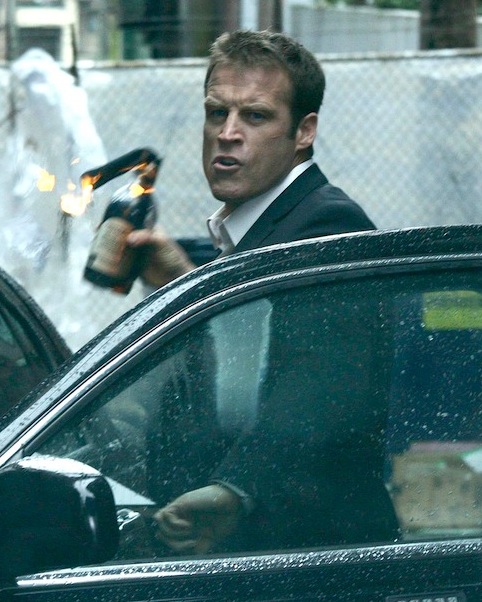
Mark Valley, who you will recognize most recently from the FOX X-Files knockoff Fringe. Don't get me wrong. I have no problem with Valley personally, or even with his acting. What I'm really tired of is the blond, square jawed, 40-something, slightly goofy sci-fi/comic book hero, who you can also see in Eureka in the form of Colin Ferugson:


and in The 4400 and V in the form of Joel Gretsch:


Am I supposed to identify with these guys?

Anyway, so I watched the premiere, all set to give a scathing review about trite reimaginings of great concepts.

Ladies and gentlemen, I LOVED it. First of all, as action-adventure pilots go, I did not find that the plot was particularly predictable or cliched, which was incredibly refreshing. Secondly, I thought Mark Valley did a fine job, and his decision to be close to his target rather than actually become the target actually made sense. Next, and perhaps more importantly, it co-starred this guy:


Whom people my age will remember as the brash Kelly Leak from the original Bad News Bears, and more recent readers will remember from his absolutely brilliant turn as Rorscach in the movie Watchmen. The character Guerrero that Jackie Earle Haley plays in the Human Target is somewhere in between, a guy who doesn't look like much, but you just know could kill you if he wanted to. You're afraid of him and you don't quite know why. This type of character is possibly my favorite in all of fiction, and Haley is perfect for him.

Finally, and equally important, is Mark Valley's Christopher Chance. To my surprise, he was neither a douchebag nor an intolerable goofball. I'm all for a good anti-hero: I love seeing House put it to his hapless team and patients every week. But it was about time for a protagonist who has his shit together (relatively speaking) and is just a good guy. That's who Christopher Chance is. Chance is a callback to old school action heroes like the A-Team's Hannibal Smith and Mission Impossible's Jim Phelps. He's cool without being an asshole, and I dig it.

Anyway, watch The Human Target. If the episodes that follow are anything like the pilot (and you like this sort of thing), it'll definitely be worth your while.

Monday, January 18, 2010

J-E-T-S...


Well will you look at this. Who would have thought it. The New York Football Jets are one game away from the Super Bowl, for the first time since 1998. It seems surreal, like some kind of dream.

The nice thing about the Jets is that they really are a team.

The only real breakout superstar is Darelle Revis. You could argue for anybody on the offensive line as well, but that’s the point. It’s ALL the guys on the offensive line, Faneca, Ferguson, Mangold, etc. who are playing at a higher level, not to mention the way the defensive line stepped up after losing Kris Jenkins for the season.

ROAD TO THE SUPER BOWL?

Will the Jets make it to the Super Bowl? Will they win it? Despite Rex Ryan’s protestations to the contrary, I still think the Jets have to be the underdog all the way. But are they capable of winning it all? Absolutely. The Jets defense has a reputation of being able to shut down high-powered offenses, and that’s what they’ll be facing the rest of the way. And if the Jets beat the Colts, in a repeat of Super Bowl III, they can quiet all the sour grapes fans complaining that the Bengals and Colts laid down to the Jets at the end of the season to make their playoff road easier. Seems the Jets had something to say about that.

BUT WHAT OF SANCHEZ??

For those who would argue that a rookie quarterback like Mark Sanchez could never make it to the Super Bowl, let alone win it, I’d like to remind us all of some other questionable quarterbacks who wear Super Bowl rings. Such unforgettable names as Trent Dilfer of the 2001 Champion Baltimore Ravens. Mark Rypien of the 1992 Champion Washington Redskins. Brad Johnson of the 2002 Champion Tampa Bay Buccaneers. Jeff Hostetler of the 1991 New York Giants. Can Mark Sanchez’ name fit in with such distinguished company? Oh yes, I think it can.

J-E-T-S JETS JETS JETS!!!

Thursday, December 31, 2009

Goodbye, Aughts


On the final day of the decade, I thought I'd write a little blog looking back on the major events of the '00s, contrasted with events in my own life. I should note that most scholars believe that the new decade actually begins on January 1, 2011, because there is no year 0 A.D., the first decade started with 1 A.D. and ended at the end of 10 A.D., and so on. But who says there was no year 0? Who was even counting back then? Just because we don't assign any historical events to that date doesn't mean it didn't happen! Maybe it was a slow year! Maybe that's why they called it year zero!

Anyway, on to the remembrances:

2000: The Republican party steals the Presidential election for George W. Bush, in an escapade that put the Watergate burglars to shame. In response, I decide to leave the country. Since these are the days before GPS, I will end up in California rather than Canada.

2001: The Twin Towers are destroyed by terrorists. Realizing we all have to do our part to band together in this time of crisis, I immediately join a graduate professional screenwriting program at USC.

2002: The New England Patriots replace Drew Bledsoe with a young upstart from Michigan named Thomas Brady and upset the St. Louis Rams to win the Super Bowl. Realizing that nothing in life makes sense anymore, I turn to female companionship for comfort and solace and start dating Elizabeth Saas, a relationship that I am hoping has outlived the Patriots' dynasty.

2003: The Human Genome Project is completed. I graduate with a professional screenwriting degree. While both events were greeted with great hope and celebration, neither has yet to produce any discernible results.

2004: Pamela Anderson once more poses for Playboy. I begin teaching her son Dylan chess to give his life some balance.

2005: A phenomenal year for me, as I win one screenwriting contest, come in second in a bigger one, and find myself runner up to Men "The Master" Nguyen in a Legends of Poker preliminary event. I assume this is presaging great things to come. I am wrong, at least in the short term. I should have guessed there would be trouble when the Pope was succeeded by former Nazi Joseph Ratzenberger.

2006: Google buys YouTube. I respond by creating this blog. My first two posts are about liking the Da Vinci Code without shame and the trials of querying agents and producers.

2007: I finally get my first real agent. The Writers Guild immediately goes on strike, shutting down all production and any hope of getting work in Hollywood.

2008: My contract with my agent expires. A month later the WGA strike is resolved.

2009: Michael Jackson dies. I am selected as a finalist in the FilmStream Screenplay competition. As one history-making career ends, another is about to begin.

Bring on 2010!

Saturday, December 12, 2009

Catching a Tiger by His Tail


First, a little bit of business. I'd like to call your attention to the new "Follow" links that should be on top and to the side of the page. If you have a Google account, these buttons seem to provide a quick and easy way to follow this blog, so there's that. Also, I've added "The Oatmeal" to my blogroll. The Oatmeal is a hysterical site created by web designer Matthew Inman which includes some gut busting cartoons and fun quizzes and you should check it out. Finally, happy birthday to my friend and loyal CraigsHappyPlace reader Bill Saas, who turns 21 today or something.

Anyway, on to the good stuff. Tiger Woods. Oh, Tiger, Tiger, Tiger. Multiple allegations of the world's greatest golfer's infidelity have emerged, and while some may be bogus, voicemails, texts and the golfer's own admissions reveal that some are in fact true. Tiger's been steppin out on his wife. For awhile. This has become the top sports story of the year, without question. But why? As my girlfriend pointed out, it's not like a professional athlete never cheated on his wife before.

This is true. However, there are a lot of things that make this particular story very special.

First of all, Tiger Woods is not a professional athlete. He is THE professional athlete when it comes to golf. His name is synonymous with golf. He is what Michael Jordan is to basketball, what Roger Federer is to tennis, what Wayne Gretsky is to hockey. In the eyes of many, these men are perfect. Infalible. So when they stray, when they give us something that reveals to us that they are indeed human, too, we cannot look away.


Secondly, golf is an individual sport. When a football player is accused of a crime, his teammates often rally around him. In golf, everyone else (other than the sponsors) is Tiger's enemy. If he gets into trouble, there's nowhere to hide.


Thirdly, Tiger is someone with a pristine image in a sport with a pristine image. The whiter the cloth, the better the dirt shows up.


Additionally, we seem to have gotten lucky. If not for this car accident on Thanskgiving, none of this ever would have come out. For whatever reason, before the allegations surfaced, all of these women were willing to keep Tiger's secret. Then when the first one talked, they fell like dominoes (It's quite amazing to see the reaction of attractive, greedy young women to the scent of money. It's like blood in the water for sharks, literally stirring them into a frenzy). Now that we know, we have to know more. Everyone loves to be in on a good secret.


So, knowing why the Tiger story is so big, let's look at some of the interesting reactions to it. Here are some of the top questions that the public and the media have had about Tiger's Trysts:

1. How come Tiger gets with so many white girls?

It seems that while not as fair-skinned as his Nordic bride, the girls Tiger is cheating with are mostly white, or at least, don't reflect a lot of ethnic diversity. Now, cheating is cheating, and Tiger is obviously going to cheat with whoever he finds most attractive, but this little fact may lose him some sympathy among minority fans. We don't know what it means anyway. Are white women objectively more attractive, or just objectively sluttier? Or perhaps these were the only women he could get into the Golf Clubs as guests.

2. Waitaminute! Tiger's wife is hot! WTF??

This just goes back to the old saying: You show me a drop-dead gorgeous woman, I'll show you a guy who's tired of f***ing her. Many of us look at Elin Nordegren and wonder how Tiger could possibly not be satisfied, but that's because we can't have her. There's nothing so attractive as what is new. Man is never satisfied. That is what has allowed him to achieve so much.

3. How could that woman release that voicemail? She's a homewrecking whore! That poor family!


I actually heard a woman say something to this effect on talk radio, which I think is a sad commentary on the state of feminism in this country. However you feel about adultery (which if you are one of these anti-gay marriage fanatics, I assume you would like a law passed against it), there's no question who is at fault for damaging this family. That's on Tiger, and no one else. He played, and he's got to pay. These women didn't take any vows.

4. How could Tiger betray us like this?

OK, Tiger Woods doesn't owe you a damn thing except great golf. If you had an image of Tiger that has been shattered, that's on you, not him. It's unfortunate, but people are human and make mistakes, especially people who grow up with the entitlement that professional athletes do. If you want to reduce your chances of being disappointed, make someone like Judah Folkman or Muhammad Yunus your idol.

Well, that's it for now. See you at the next celebrity scandal!

Saturday, November 28, 2009

Healthy Debate


The latest battle in the health care reform war is between the House health care bill and the Senate health care bill. Although the House bill was passed with much fanfare by the Representatives, it is the Senate bill, or some modified version of the Senate bill, that will ultimately pass, for two reasons. The first is that the Senate just generally gets more respect than the House, since there are fewer Senators and they serve for longer (also “Senator” just sounds cool).

The more important reason is that although the House bill would probably be better for the average American, they have managed to construct it so that there is a reason for everyone to hate it. In a good negotiation, all the parties involved should believe they got a little more than they should have. With the House plan, everyone gets to feel like they got a lot less. The New York Times did a breakdown of some of the key differences in both bills. Let’s look at them to see why the House bill could never become law.

Public Option: Both plans have a public option, but the Senate plan would allow individual states to opt out. Having options sounds great, but what this means is that states with strong pro-corporate lobby groups could kill a public option in states that really need one, states where the big insurance companies are crushing average citizens. As far as the average American goes, the House gets the edge on this one. However, strong proponents of states’ rights, the ideology of say, your average center-right Republican, now have a reason to hate the bill.


Employer Contribution: House plan: Most businesses are required to provide insurance or pay an eight percent payroll tax. Senate plan: Employers are not required to carry insurance for employees but if they have 50 or more employees must pay a $750 penalty per worker if any workers receive federal subsidies. What would happen here under the House plan is probably that most people with jobs would get insurance. Under the Senate plan, employers with over 50 employees would simply make sure that their employees make enough so that they do not qualify for Federal subsidies, or, failing that, hold steady at 49 employees. Again, as an average working stiff, you probably want the plan where they have to give you insurance. As a small business owner, however, you now have a reason to hate the House plan.


Abortion: Those receiving Federal subsidies for insurance can’t get a plan that covers elective abortions under the House plan. The Senate plan allows choosing a plan that covers abortion, but subsidies cannot be used to pay for the abortions. The Senate plan isn’t much better, but guess what? Now everyone who is pro-choice has a reason to hate the House plan.


Illegal Immigrants: Under the House plan, illegal immigrants can get national health coverage, but not with Federal subsidies. Under the Senate plan, illegal immigrants can’t. If illegal immigration is your issue, you now have a reason to hate the House plan.


Paying for the Plan: A 5.4% surtax on high income people pays for the House plan. This by itself is enough to send the average conservative spiraling into a rage. Those on the left will argue that this is a very small percentage of the population and the tax will not affect their lifestyle significantly, while a health care plan will ultimately bring down taxpayer health care costs due to fewer emergency visits and more preventative care. The very rich, and many of those who plan to someday be very rich (which is essentially, everyone else), will be outraged at the prospect of shouldering the entire burden for keeping the poor (who many of them hate and find responsible for their own poverty) healthy. Now the wealthy and those who aspire to wealth hate the House plan.


Clearly, most of the provisions of the House plan are going to be abhorred by your right wing conservatives, but there is enough in there for those on the left and center-left to find disagreeable too. The Senate plan, by being less offensive to everybody, will also probably be less effective, but more likely to pass, or at least pass in a modified form.


That’s politics for you!

Lions in Wait

In honor of Thanksgiving, here is a letter I wrote to the General Manager of the Detroit Lions:

Let me begin by saying that I am not a Lions fan. In fact, my interests lie mostly in the AFC and I have no feelings about the Lions one way or the other. However, I see a way to help your team and feel it would be immoral to remain silent. While at first glance my solution may seem flippant, I hope you will consider all the evidence I will present on its behalf.


Your team needs a uniform redesign. A radical one.


Clearly to suggest that what someone wears is more important than strategies or personnel seems ridiculous on its face, but psychological studies have shown that certain colors tend to stir up certain emotions in people and may make them more or less competitive. I refer you to studies that have experimented with painting prisons pink to tranquilize the inmates. You can be sure that when the list of colors that stirs up competitive instincts and emotional fire is reviewed, Honolulu Blue is not found among them.


I would ask you to look at the empirical evidence. In 1993, the New England Patriots ditched their traditional colors and their unintimidating “Pat the Patriot” logo, instead adopting a streamlined symbol with deeper, more modern colors. In the 25 years prior to that, the Patriots had made only a single Super Bowl appearance where they were soundly beaten by the Chicago Bears. Four years after the change, the Patriots were in the Super Bowl, and four years after that, they began a dynasty that included three NFL championships in four appearances.


Throughout their entire existence, the Tampa Bay Buccaneers were the laughingstock of the NFL. They even included 14 consecutive losing seasons among their credits, all with their “creamsicle” colors and what some said was an effeminate “Bucco Bruce” logo. In 1997, they exchanged Florida Orange for metallic gold to go with a blood red and skull and crossbones logo. Four years later, they began a season that ended with them hoisting the Vince Lombardi Trophy.


Lest you argue that it is the team, and not their colors, that determine victory, I would ask you to take a look at the Cleveland Browns, whose name in the NFL is synonymous with failure. In 1996, the team moved to Baltimore, requiring as radical a uniform change as there has ever been in the NFL. Four years later, the Baltimore Ravens were a championship team, while the Browns that replaced them, wearing their old, featureless orange helmets and brown and white uniforms, have shown no signs of life whatsoever.


If you want to win, just look at the evidence. Uniforms do make a difference. Ditch the Honolulu Blue for a deeper blue, black, or even something more befitting a lion like a deep orange. Make the silver more metallic and replace the logo with a more fearsome lion. The recent redesign of the emblem is a vast improvement over the amorphous blue blob that used to grace the Lions' helmets but it is not nearly enough.


I hope that you or whoever reads this letter will give these suggestions the credit they are due. Remember that I am not a Lions fan and have nothing invested in whether or not you take these suggestions to heart, only that I know that it will make a difference.


Thank you for your time and attention,


Craig Berger


If you're a Lions fan, you can thank me when they win the Super Bowl, four years after my uniform redesign plan is implemented.

Wednesday, November 04, 2009

The Visitors Are Your Friends (But not on Facebook)


Like many people of my generation, I eagerly awaited the debut of ABC's "reimagining" of the classic 1980s T.V. miniseries "V." When "V" came out, it was a member of a now dead breed: The watercooler show. These were shows that everyone had to make an appointment to watch, because they would be what everyone was discussing at the water cooler (or in my case, the water fountain) the next day. In the modern era of DVRs and On Demand programming, of course, such events no longer exist.

"V" came out during a time that was starved for good science fiction on television. The Next Generation of Star Trek was still five or so years away, and the idea of a "Sci Fi Channel" was in itself science fiction at the time, so "V" drew huge audiences, expecting to see some cool aliens and maybe a space battle or two.

What they got was a well-crafted allegory of the dangers of allowing too much power to authority. To be precise, it was a Nazi story. If you'll look at the Visitors classic symbol, you'll notice it's really just a swastika with a couple of the lines removed:

The original "V" developed slowly. In fact, even the marketing campaign developed slowly, beginning with advertisements depicting amicable Visitors above the tagline "The Visitors Are Your Friends" which, as the weeks progressed towards the debut, became "tagged" with the classic V sign. With the new "V", we pretty much know right away that the Visitors are trouble, even before the final act when we get to see a bit of reptile flesh.

The new V also tries to get political. With Nazism no longer the hot button political issue of the day (the original was a mere four decades removed from World War II, today we are about as far from the Nazi heyday as those in WWII were from the Civil War), V tries to include more relevant issues, including terrorism (the FBI is tracking a Visitor "sleeper cell") and universal health care (The Visitors are offering it, taking Congress off the hook).

The problem, I think, is that the creators of the new "V" aren't looking at the big picture. The first "V" was warning us not to put too much faith and confidence in authority and government (particularly appropriate for the time it was released). That is hardly any danger today. One can only imagine what Glenn Beck would have to say on his program about the Visitors, or worse yet, Lou Dobbs. Today's message of warning should be not to allow ones' actions to be governed by fear. Fear is what has been the greatest threat to economic recovery and it is behind a message of fear that America has gotten embroiled in two costly wars. Fear is the Nazi bugaboo of today.

This is the opportunity that the new "V" missed. Why not have the Visitors promise to protect us against terrorism? Maybe even have Anna, the Visitor's leader, round up a few Al Qaedas for us. That would be the way to gain our trust and make us ripe for the slaughter. Perhaps even have the Visitors convince us that they have come to protect us from an even greater threat that lies beyond the stars. By failing to do this, I think "V" has missed the mark.

Another way they missed the mark is through their use (or lack thereof) of modern technology. The Visitors announce themselves through a giant broadcast on the bottom of their spaceships. But why not use Twitter? or Facebook, or MySpace? Especially if you're looking to recruit young people. I'm sure there are already in real life "V" social media pages, but they are for multimedia promotion, not as part of the story. How about have the Visitor speeches come in podcasts downloadable on iTunes? It's hard to imagine that the Visitors would not be aware of and be able to take advantage of this technology.

Comparing a single one hour episode to an entire miniseries is not fair, I'll admit, but I'm afraid that we are already seeing a few signs that "V" is going to be just another average sci fi show. And in a world where "SyFy" the channel (not to mention 100 other channels) is no far-off futuristic fantasy but a genuine, ratings share-siphoning reality, average sci fi is not good enough.

Sunday, October 25, 2009

Rick James Would Be Proud

Steven Levitt and Stephen Dubner have come out with a sequel to their surprise hit, Freakonomics (entitled, simply "SuperFreakonomics") and it is every bit as entertaining and fascinating as the original. At the same time, a new Malcom Gladwell collection "What the Dog Saw," is hitting the shelves.

You'll probably find these two side-by-side at your local bookstore, as the popular wisdom seems to be that these three are in the same practice of writing books on what seems to me to be best described as "pop-sociology," although Levitt is an economist and Gladwell is a historian. The reality, however, is that in this particular field, Gladwell, as hard-working, prolific and intelligent as he might be, is not fit to shine Levitt and Dubners' shoes.

The difference between Levitt/Dubner and Gladwell is the difference between Rocky Road and vanilla ice cream. Rocky Road isn't for everyone, but it certainly has a lot of flavors to consider, while vanilla is safe and digestible, but ultimately, somewhat unsatisfying. The eater feels like something is missing.

So it is with Gladwell, the Bing Crosby to Levitt & Dubners' Mick and Keith. Gladwell is much less likely to stir controversy, his conclusions in books like Blink, The Tipping Point and Outliers are nearly universally hailed as groundbreaking and revolutionary, and very rarely challenged in popular media (perhaps despite Gladwell's protestations to the contrary). On the other hand, Levitt & Dubner, with assertions such as that there is a causal link between abortions and drops in crime rates, are regularly excoriated by both the right and the left.

My own feeling is that what is missing from Gladwell's work is some kind of practical application; indeed, Gladwell doesn't even seem to be looking for one. While Levitt/Dubner's work easily lends itself to all sorts of ideas about how we can change the world and why we do or don't, in every area from education to climate change, Gladwell's work seems more about wry observations of why things are how they happen to be, with little concern about what that means for the future.

Freaknomics (and SuperFreakonomics) tells us why and when people cheat and how people tend to over and underestimate potential dangers in the world. This is information that is very clearly useful, and can very obviously inform our future behaviors, if you buy into it. Gladwell's work tells us that in certain cases, people born in certain months have a greater chance of success (Outliers) that people sometimes instinctively know when something is out of place (Blink) and that certain products blow up in sales when enough of the right kind of people take an interest in it (Tipping Point). It's all interesting to be sure. But is it really groundbreaking and revolutionary? Without some kind of context, some interesting ideas about how we can manipulate such information in a useful way? Not for my money.

Speaking of my money, I bought both SuperFreakonomics and What the Dog Saw. Sure enough, Levitt and Dubner jump right in with the both controversial and useful notion that, in deaths per mile, driving home drunk is many, many times safer than walking home drunk, and moves into the idea that television empowers Indian women while at the same time leading to an overall increase in crime (not violence, but crime) all over the world, while Gladwell starts us off with story of Ron Popeil, what makes him special (he learned to make the product the star) and how he came up with the idea to invent the RonCo Rotisserie (he realized that people pay a lot for rotisserie-cooked food) and moves on to explore why Heinz has cornered the market on ketchup (they make the best ketchup).

To be fair, the Gladwell book is a compilation of some of his favorite New Yorker articles, rather than a single book concept with a unifying theme, and as he states, is not intended to persuade, but simply to give insight into how others think. It is also well-written, and well-researched, and Gladwell is to be commended for this. The Ron Popeil story, the quest to make a better ketchup, and the other stories Gladwell tells are interesting, in their own way.

That being said, if you want to read a book that will really keep you up at night thinking about things like the economics of prostitution, how terrorists are profiled and whether or not you should be more afraid of elephants than sharks, you're going to want to plunk your money down on SuperFreakonomics. I'm sure Rick James would agree.