
Sci Fi movies are hard to do well. You really have to get your audience to suspend a lot of disbelief, and if you don’t finesse it enough (or go so over the top campy that belief is not even an issue), it’s very easy to fall flat on your face. Bad sci fi movies tend to be cartoony, or completely lacking in internal consistency, or make no sense at all.
Perhaps this, then, is the reason that a few sci fi movies have really risen to the top, and year after year, these movies are upheld as the gold standard when it comes to science fiction storytelling.
I like a lot of those movies. Others I’m not so impressed with. I sort of have my own rubric when it comes to sci fi movies, and I often find that the ones I really like aren’t usually on the top of everybody else’s list.
Here then, is my list of top ten sci fi movies that aren’t on anyone else’s list of top ten sci fi movies. With each one, I’ve included the movie whose place I think it would probably take on the “real” top ten list. My choice and the popular choice won’t necessarily have anything in common, but when they do, I’ll comment on it. So, without further ado and in no particular order….
Pitch Black (Popular Choice: Alien)

Pitch Black is almost the anti-Alien. In Alien, our band of heroes is trapped in a contained space with a monster. In Pitch Black, that contained space is an entire world, and the monsters are everywhere. I’m not sure why some of the best sci fi movies are horror sci-fi. Maybe because what’s exciting about what’s out there is also what’s scary. But they are, and I love when horror tropes, like the idea that horror has to take place in dark, enclosed spaces, are turned on their ear.
Aliens, the sequel to Alien, has a lot of that, too, but what it doesn't have, in addition to the unique visual style of Pitch Black, is Riddick. The character of Riddick, before two sequels and the turning of Vin Diesel into a household name softened him up beyond all recognition, was one of the all-time great anti-heroes.
Aliens, the sequel to Alien, has a lot of that, too, but what it doesn't have, in addition to the unique visual style of Pitch Black, is Riddick. The character of Riddick, before two sequels and the turning of Vin Diesel into a household name softened him up beyond all recognition, was one of the all-time great anti-heroes.
Source Code (Popular Choice: Close Encounters of the Third Kind)
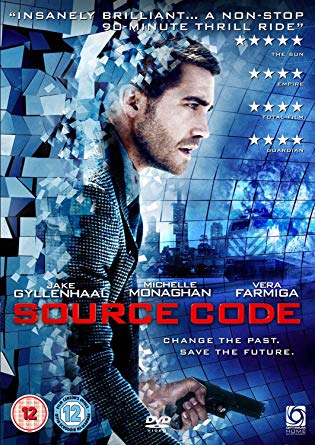
I think Source Code is a great example of a modern science fiction movie, one that a lot of movies and TV shows going forward are going to use as a template, consciously or unconsciously. It’s one of the few movies to have a credible, realistic take on something resembling time travel, and it uses concepts of VR, digital consciousness, and similar ideas that are sure to shape our world in the years to come. Close Encounters is a movie that I think was great for its time, but doesn’t quite hold up. I think movies like Contact and Arrival do a better job at expressing a realistic depiction of our first encounter with alien life.
Total Recall (Popular Choice: Blade Runner)

Listen, I am a sucker for any movie based on Philip K. Dick’s work. Minority Report, Impostor, Paycheck, I dig ‘em all. And I know Blade Runner is considered by many to be the greatest science fiction film of all time. But I think a lot of that comes from the visuals more than the story. And after having seen the overwrought, garbled, Ryan Gosling sequel, I actually like it a lot less.
Seeing the shitty remake of Total Recall, on the other hand, only reminded me how great the original was. Total Recall is Pure PKD, complete with mindfucking, bizarre adventures and non-stop action. It’s ‘80s Arnie at his finest and a timeless sci fi classic.
Robocop (Popular Choice: Metropolis)

Robocop is a movie from the same era and of the same ilk as Total Recall. What makes Robocop special, however, is how effortlessly it mixes political satire with over the top humor with cool cyborg action. What was so horrifying about the shitty remake of this one is that it wasn’t funny. Like, not even a little. Like, it makes you want to hang yourself.
Metropolis may have been funny, but I couldn’t tell you, because I had no idea what the hell was going on for most of it. It seems like mainly a mashup of science fiction tropes that were popular in 1927, and I think it’s just the idea of a “science fiction art film” that has people so seduced by it.
The One (Popular Choice: 2001 A Space Odyssey)

When it comes to cultural cachet, “The One” and “2001: A Space Odyssey” are on opposite ends of the spectrum. 2001 is hailed as Kubrick’s masterpiece, while a lot of people think that “The One,” belongs in the discount bin at Walmart. To these people I say:
Are you fucking kidding me? A science fiction martial arts movie that dealt with parallel universes before that was even really a thing in movies and that ends (SPOILERS) with the hero’s evil twin playing a literal game of King of the Hill in a Hell Dimension warding off countless waves of kung fu fighting doppelgangers? How is that not on EVERYONE’S “best” list?
Star Trek VI: The Undiscovered Country (Popular Choice: Star Trek II: The Wrath of Khan)

I’m not going to make the argument that VI is an objectively better movie than II. I don’t expect I could ever win. What I’ll say is that I think Star Trek II embodied the best of what Star Trek was, while Star Trek VI embodied the best of what it could be. That, and the cultural relevance of the Cold War parallels that were so meaningful at the time VI was released is what puts it over the top for me. I think both movies are head and shoulders above every other Star Trek movie before or since.
Edge of Tomorrow (Popular Choice: E.T.)

The science fiction movie I loved most in the last ten years (maybe more) has to be Edge of Tomorrow. Based on a Japanese novel with the lost in translation name of “All You Need is Kill,” Edge of Tomorrow is fun, it’s funny, it deals with alternate realities/time travel in a convincing way, the characters are compelling and easy to sympathize with and the characters’ goal is noble and relatable. If you have not seen this movie because you hate Tom Cruise, or because you thought the premise was silly, or just because it escaped your notice, do yourself a favor and go see it (I think it has been retitled: Live, Die, Repeat)
Oh. It has no relationship to E.T. other than the initials and, you know, aliens. E.T. is a fine movie and you all should see that one too if you haven’t.
Tron (Popular Choice: The Matrix)

Full disclosure: The Matrix and I got off on the wrong foot. I saw it for the first time after being up all night studying for something or other and did not even really follow the story. I have seen it since and I get the premise, which does not make a lot of sense (why do the machines need to create this elaborate fantasy world for people just to feed on them? Doesn’t this take more energy than it provides?). I admire the Wachowskis for having and presenting a unique vision of a sci-fi world, but again, in a time where virtual reality machines are par for the Sci Fi course, it doesn’t really hold up.
Tron, with its “digital” world of 8 bit graphics doesn’t quite hold up either, but it fails to do so in an incredibly charming way, and Tron is a classic adventure story that doesn’t even really need the sci fi element, but it’s great that it has it because light cycles and identity discs are fucking cool.
Return of the Jedi (Popular Choice: The Empire Strikes Back)
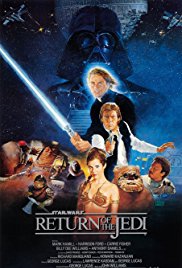 Second full disclosure: I am a terrible Star Wars fan. One, I liked the Phantom Menace, also, when I played with my Star Wars action figures I always pretended they were characters from other franchises, and worst of all, I liked Return of the Jedi better than Empire. I blame this on the fact that I saw these movies when I was a kid, and when I watched Empire, I still really didn’t understand the concept of sequels or trilogies.
 At the end of Empire, I thought that was it, it was over, Darth Vader won and the heroes lived miserably ever after, and as a child, that was deeply unsatisfying. Return of the Jedi gave me the closure I desperately needed. The opening sequence on Tatooine, where all the heroes (save Han) are in their full leveled-up glory defeating Jabba the Hutt, is one that burned itself into my memory and inspired my love of sci fi all the more. If I had seen these movies when I was older and more cynical, I’d probably have a very different take, but, there it is.
Escape from New York (Popular Choice: The Terminator)

I have nothing bad to say about the Terminator. I love the Terminator. It’s just that it’s bound to appear on anyone’s top 10 list. Escape from New York might not, although it should. Snake Plissken may be the greatest sci-fi anti-hero of all time. He makes Han Solo look like Jar Jar Binks. Snake stares death in the face, laughs at authority, but in the end, still saves the day, albeit in his own inimitable fashion. The way in which the film turns 1990s New York into the hellscape everyone outside of New York seemed to think it already was is another reason this film is rightly considered a sci-fi classic.


 A wormhole functions according the idea that spacetime is curved, and there can essentially be a situation where a bridge is created cutting right through that curve, a sort of tunnel between an earlier and later time. In other words, if time were a straight line ----, it would take you a certain amount of time to get from point A to point B. But if time were more of a “C” shape, you could get from one end of the C to the other much faster by cutting through it rather than going around the curve.
 This still does not address my aesthetic objection, which you’ll remember was that time travel stories are simply messy: Specifically, it 1. disrupts continuity and makes it difficult to invest in the characters, and 2. creates the slippery slope: You go back and change something, I go back and fix it, you go back and unfix it, ad infinitum. To close out this extended rant, I’d like to take a look at how some time travel stories handle all this and how effective I think it has been.
  I frankly think that time travel has made Star Trek a pretty big mess. You can argue with the last movie that the Romulan time trip created a new, alternate timeline, and that the initial timeline is moving forth as it always had (albeit without a Spock). That’s okay, I guess, but I suspect we will never see our “real” timeline again, and even that timeline has been removed by so many jumps it hardly matters (for example in Star Trek, First Contact, the Borg go back in time and take over Earth, radically changing its history. The Enterprise crew goes back and fixes it. However according to the Many Worlds theory, the initial timeline was unchanged by the Borg, and the Borg’s new timeline was unchanged by the Enterprise; we simply have three different universes in effect. Yes I have a headache now too).
 Back to the Future alludes to the Many Worlds theory, but not quite effectively. Dr. Brown does explain how moving through time creates an alternate timeline. However, he creates a sticky situation when he does a test run by sending his dog three minutes into the future. The dog has clearly reappeared in the same timeline, which forces us to confront the possibility that somehow moving ahead in time does not create new timelines while moving backwards does. Marty also finds that changing the past is affecting his original present (the picture with his siblings disappearing as they are “uncreated”), which gives rise to the “grandfather paradox” anew.
 Sliders handles the wormhole idea pretty well, but its protagonists are jumping through dimensions, not moving through time and space. There are no paradoxes because they never encounter the same timeline twice, although Quinn Mallory’s quest to return to his home dimension may prove impossible.
 Members of the Legion of Superheroes travel freely back and forth through time with little concern about the consequences. The mainstream DC universe has not created a very sophisticated look at time travel although they used to have an interesting conceit where if you went back to a time where you already existed, you would appear as a wraith, since the same person cannot “be in two places at once.”
  Terminator time travel isn’t too unwieldy for a number of reasons. The first is that only a handful of people go back before the time travel device is destroyed, and they can’t travel the other way. There are still some paradox issues, but since time travel is used so sparingly, it doesn’t interfere with the story too much.

 The Novikov Self-Consistency Principle simply states that anything that cannot happen, will not happen. In other words, if you go back in time and try to kill your grandfather, you will always fail. Your gun will misfire at the last minute, you will have shot the wrong person, or the right person but it will turn out that he wasn’t your grandfather after all, etc. The television show
 The many worlds theory, popularized in D.C. Comics with their “multiverse,” and based on the


 Again, the physical objection is no big deal. Superman shouldn’t be able to fly either and I’m fine with that. I’m also not too caught up in the metaphysical problems, but I should address them as well.
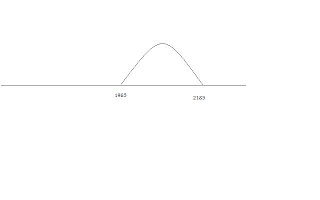
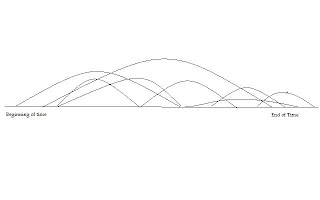 For as long as human beings exist in time, people will be going back, making anachronistic holes in the time line like so much swiss cheese. With an infinite number of travelers, eventually one will make time travel technology possible at an earlier time, which will then lead to infinitely more travelers between that earlier time and other times, until time travelers are EVERYWHERE. And as far as I can tell, they are not.